Noise-canceling headphones are a popular choice for many people who want to enjoy their music or audio content without being disturbed by external noises. Whether you’re on a plane, train, or bus, or in a noisy environment like a coffee shop, noise-canceling headphones can help you block out unwanted sounds and focus on what you’re listening to. But how do these headphones actually work, and what makes them different from regular headphones?
In this article, we’ll explore the technology behind noise-canceling headphones and how they’re able to cancel out external noises. We’ll look at the two main types of noise cancellation – active and passive – and how they work in different types of headphones. We’ll also discuss hybrid noise cancellation, a newer technology that combines both active and passive techniques to provide even better noise reduction.
If you’re thinking of buying noise-canceling headphones or just curious about how they work, this article will provide you with a comprehensive understanding of the technology behind them. So let’s dive in and discover the fascinating world of noise-canceling headphones!
This Post Contains –
Types of noise-canceling headphones
There are two main types of noise-canceling headphones:
- Over-ear and
- In-ear.
Over-ear noise-canceling headphones, also known as circumaural headphones, have ear cups that completely cover the ears. They typically provide better noise isolation than in-ear headphones. They are more comfortable to wear for extended periods of time. Over-ear noise-canceling headphones are also larger and bulkier than in-ear headphones, making them less portable.
In-ear noise-canceling headphones, also known as earbuds or in-ear monitors, fit directly into the ear canal. They are generally smaller and more portable than over-ear headphones but may not provide as much noise isolation or comfort.
On-ear noise-canceling headphones, which have smaller ear cups that rest on the ears rather than completely covering them, are also available. These headphones provide some noise isolation but not as much as over-ear headphones.
It’s important to consider which type of noise-canceling headphones is best for your needs based on factors such as comfort, noise isolation, portability, and sound quality.
How Do Noise Canceling Headphones Work?
How to Active Noise Cancellation (ANC) Works?

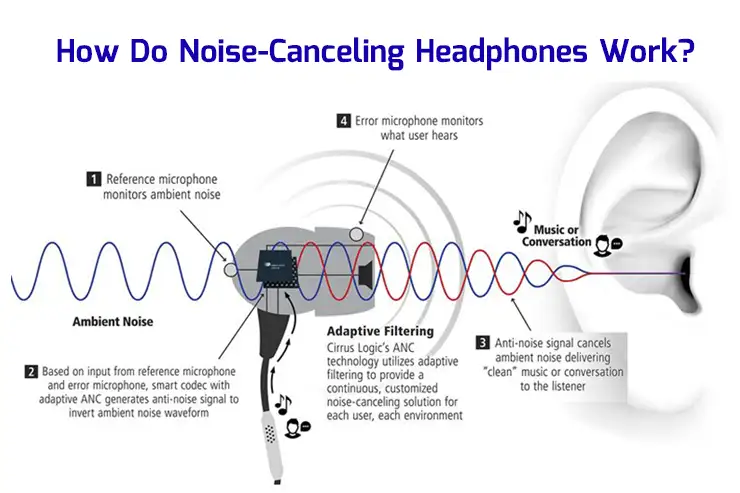
Active noise cancellation is a technology that uses microphones and advanced signal processing to actively cancel out external noises. It works by detecting external sounds with a microphone, generating an “anti-noise” signal that’s the opposite of the incoming sound wave, and playing this signal back through the headphone’s speakers. The anti-noise signal cancels out the original sound wave, resulting in a quieter listening experience.
This is done by the following steps:
- Microphones record noises
To implement ANC, noise-canceling headphones use one or more microphones to pick up the sound waves in your environment. These microphones are usually located on the ear cups or earbuds of the headphones and can detect sounds from all directions.
- Signal processing and sound waves
Once the microphones pick up the external sound waves, the headphones use signal processing to analyze and process the sound data. The processed data is then used to generate an opposite sound wave that cancels out the external noise.
- Anti-noise sound Producing
The opposite sound wave that cancels out the external noise is called “anti-noise.” This anti-noise is generated by a built-in amplifier in the headphones and is played through the headphone speakers. When the anti-noise meets the external noise, they cancel each other out, resulting in a quieter listening experience.
- Anti-noise waves played by speaker
In order for ANC to work effectively, noise-canceling headphones need to have good sound insulation. This means that the headphones should create a seal around your ears or in your ear canal to prevent external noise from leaking in. Over-ear headphones are usually better at providing sound insulation than on-ear or in-ear headphones.
How to Passive Noise Cancellation (PNC) works?
Passive noise cancellation, which is also known as noise isolation, works by physically blocking external noise from reaching the ear. This is achieved through the design of the headphones themselves, which creates a barrier between the ear and the surrounding environment.
The most common method of passive noise cancellation is the use of ear cups or ear tips that create a seal around the ear canal. This seal helps to block out external noise, similar to how earplugs work. The effectiveness of passive noise cancellation depends on the quality of the seal and the materials used in the headphones.
Passive noise cancellation does not require any additional power source or electronic components, making it a simple and cost-effective solution for reducing external noise. However, it may not be as successful in blocking out low-frequency noise or abrupt loud sounds as active noise cancellation.
Passive noise cancellation can be found in both over-ear and in-ear headphones, and is often used in combination with active noise cancellation for even better noise reduction. When choosing noise-canceling headphones, it’s important to consider both passive and active noise cancellation features to determine which headphones will best meet your needs.
Hybrid Noise Cancellation (HNC)
Hybrid noise cancellation, also known as adaptive noise cancellation, is a combination of both active and passive noise cancellation technologies. It uses microphones to pick up external noise and then generates an “anti-noise” signal to cancel out the external noise, while also providing a physical barrier to block out remaining noise.
Hybrid noise cancellation works in a similar way to active noise cancellation, with the addition of a microphone that picks up external noise. The microphone feeds this noise into a processor, which generates an opposite sound wave to cancel out the external noise. The resulting sound is then played through the headphones, effectively canceling out external noise.
However, hybrid noise cancellation also includes the use of physical barriers to further reduce external noise. This can include ear cups or ear tips that create a seal around the ear canal, similar to passive noise cancellation.
The combination of active and passive noise cancellation creates a more effective solution for blocking out external noise, especially for low-frequency sounds. Hybrid noise cancellation can provide better noise reduction than either active or passive noise cancellation alone, making it a popular choice for high-end noise-canceling headphones.
Overall, hybrid noise cancellation is a powerful technology that combines the benefits of active and passive noise cancellation, resulting in improved noise reduction and better sound quality.
How to Choose Noise Canceling Headphones
Choosing the best noise-canceling headphones can be a bit overwhelming, as there are many different factors to consider. Here are some important factors to check when choosing the best noise-canceling headphones for you:
- Type of headphones: Decide whether you prefer over-ear, on-ear, or in-ear headphones based on your comfort and noise isolation preferences.
- Active noise cancellation: Check if the headphones have active noise cancellation technology, which is the most effective way to cancel out external noise.
- Battery life: Consider the battery life of the headphones, as active noise cancellation technology requires power.
- Sound quality: Check the sound quality of the headphones, as noise cancellation can sometimes affect the overall sound.
- Comfort: Consider the comfort of the headphones, especially if you plan to wear them for extended periods of time.
- Price: Determine your budget and look for headphones that offer the best value for your money.
- Brand reputation: Consider the reputation of the brand and the customer reviews to get an idea of the quality and reliability of the headphones.
- Additional features: Look for additional features such as touch controls, built-in microphones, and wireless connectivity if they are important to you.
By considering these factors, you can find the best noise-canceling headphones that fit your needs and preferences. Its really hard to decide if you are not headphone professional. So, you can follow Headphonicity’s review page Best of the Best.
Can noise cancelling headphones cause dizziness?
There is some evidence that noise-canceling headphones can cause dizziness or disorientation in some people. This is thought to be due to the way that noise-canceling technology works by creating “negative” sound waves to cancel out external noise.
This can interfere with the way that our brain processes auditory information, leading to feelings of dizziness or disorientation.
Additionally, when noise canceling headphones are blocking all external sounds, it can make us lose sense of our surroundings, and this can cause dizziness or disorientation. It’s also important to note that some people may be more sensitive to this effect than others.
Prevention and Solution
However, it is important to note that this is not a common side effect, and most people do not experience any negative effects from using noise-canceling headphones. If you do experience dizziness or disorientation while using noise-canceling headphones, it is recommended that you stop using them and consult with a medical professional if the symptoms persist.
It is also a good idea to take regular breaks when using noise-canceling headphones, and to use them at a moderate volume to prevent any possible negative effects on the ear. If you find yourself getting disoriented or dizzy, you should remove your headphones and take a break.
Can you use the noise cancelling headphones to give you silence or do you have to play music?
Yes, you can use noise-canceling headphones to reduce or eliminate background noise, even if you are not playing music or other audio content. When you turn on the noise-canceling feature on your headphones, the microphones on the headphones will pick up external sounds, and the computer chip inside the headphones will generate sound waves that are the exact opposite of the incoming noise. This effectively cancels out the background noise, giving you a quieter environment to focus or sleep.
It’s important to note that noise-canceling headphones will not completely eliminate all background noise, but they can significantly reduce it to a point where it is barely noticeable. It also depends on the quality of the headphones, some of them are better than others in terms of noise cancellation.
Active vs Passive Noise cancellation: Which is better?
Both active and passive noise cancellation headphones have their own advantages and disadvantages. Active noise cancellation (ANC) headphones use a microphone to pick up external sounds, which are then processed by a computer chip to generate sound waves that are the exact opposite, or “negative,” of the incoming noise.
These negative sound waves effectively cancel out the background noise, resulting in a quieter listening experience. They can reduce a wide range of noise frequencies and it can be adjusted to the specific noise environment.
Passive noise cancellation, on the other hand, works by physically blocking out external noise. This can be done through the use of materials, such as foam or other sound-absorbing materials, that block the sound waves from entering the ear.
Passive noise cancellation can also be achieved by creating a good seal around the ear cups, which blocks out external noise by physically blocking the sound waves. It’s more effective for blocking out low frequency noise like hum of an airplane engine or traffic.
Active noise cancellation is generally considered to be more effective than passive noise cancellation in terms of reducing background noise and providing a better listening experience.
However, it can be more expensive and complex, and it requires power. Passive noise cancellation is simpler, cheaper, and don’t need power but can’t be adjusted to the specific noise environment. Both active and passive noise cancellation can work together in the same headphones to provide the best noise reduction possible.
In conclusion, it depends on your needs and preferences, if you need to block out a wide range of noise frequencies and you don’t mind spending more money and having a device that needs power, active noise cancellation headphones are a better option. If you want a simpler and cheaper solution, passive noise cancellation headphones are a good choice.
FAQs
What is the difference between active and passive noise cancellation?
Active noise cancellation uses electronic circuitry and microphones to generate sound waves that cancel out external noise, while passive noise cancellation relies on the physical design of the headphones to block out external noise.
Do noise-canceling headphones block out all external noise?
While noise-canceling headphones are very effective at reducing external noise, they cannot completely eliminate all noise. Some external noise, especially sudden or very loud sounds, may still be audible.
Can noise-canceling headphones be used without music?
Yes, noise-canceling headphones can be used without music or any other audio source, as the noise-canceling feature is separate from the audio playback.
Can noise-canceling headphones cause headaches?
While some people may experience headaches or discomfort from wearing noise-canceling headphones for extended periods of time, this is not a common issue. It’s important to take breaks and adjust the fit of the headphones to ensure comfort.
Can noise-canceling headphones affect sound quality?
Noise-canceling headphones can sometimes affect the sound quality, especially in cheaper models. However, high-quality noise-canceling headphones are designed to provide excellent sound quality while reducing external noise.
Can noise-canceling headphones be used for phone calls?
Yes, noise-canceling headphones can be used for phone calls, and many models include built-in microphones for this purpose.
Are noise-canceling headphones worth the investment?
Whether or not noise-canceling headphones are worth the investment depends on your needs and preferences. If you frequently work or travel in noisy environments, noise-canceling headphones can greatly improve your experience by reducing external noise and allowing you to focus on your work or entertainment.
Conclusion
In conclusion, noise-canceling headphones are an essential tool for anyone who needs to block out external noise and focus on their work or entertainment. Whether you’re a frequent traveler, a student studying in a noisy environment, or simply someone who enjoys high-quality audio, noise-canceling headphones offer a range of benefits that make them worth considering.
Passive noise cancellation, active noise cancellation, and hybrid noise cancellation are the three main types of noise-canceling technology, each with their own advantages and disadvantages. When choosing the best noise-canceling headphones for you, it’s important to consider factors such as the type of headphones, active noise cancellation, battery life, sound quality, comfort, price, brand reputation, and additional features.
By understanding how noise-canceling headphones work and what factors to consider when choosing the best headphones for you, you can make an informed decision that will enhance your audio experience and improve your productivity in noisy environments. Whether you’re looking for over-ear, on-ear, or in-ear headphones, there is a noise-canceling option that will suit your needs and preferences.